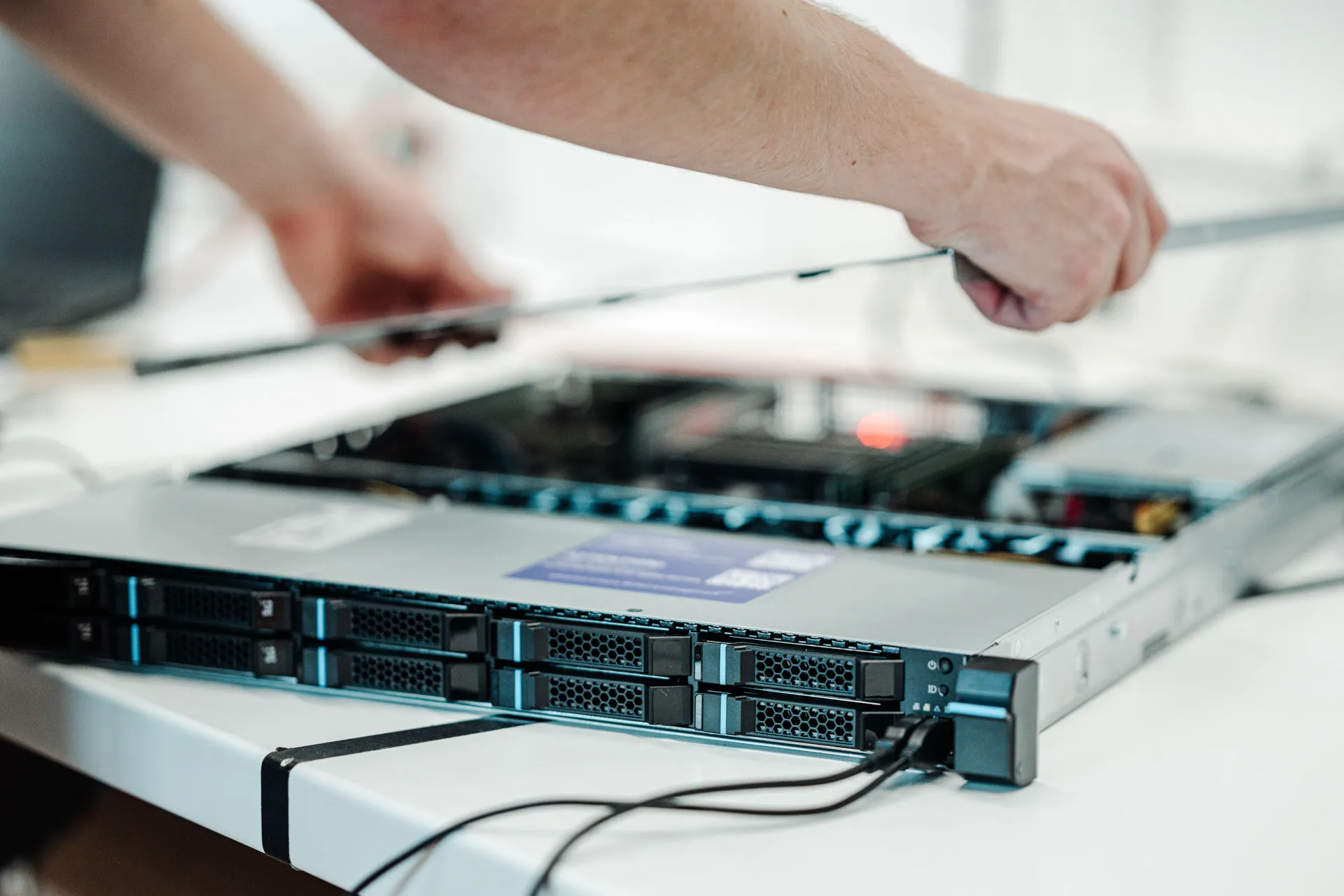

High Availability for Servers & Storage
Resilient server and storage infrastructure – as a turnkey appliance or software-based, vendor-neutral advice.
Who is it for?
Companies for whom a failure of servers or storage systems would immediately jeopardize operations.
A single server carrying your entire business operation is a single point of failure: if it breaks, your company grinds to a halt until replacement hardware arrives and the backup is restored – which can take hours to days.
- How long could your company afford a complete server or storage outage?
- Do you know whether your current infrastructure can survive a hardware failure without downtime?
- Is a daily backup enough for you, or do you need genuine resilience without interruption?
Three paths to high availability
For your server and storage infrastructure, we offer three approaches: TERRA XALER from Wortmann is a pre-configured two-node cluster appliance – Hyper-V virtualization, storage, and networking already matched to each other in one unit, with synchronous data mirroring between both nodes and automatic failover in the event of a complete outage. Alternatively, we set up a software-based solution with DataCore SANsymphony or StarWind vSAN on your existing or freely chosen hardware – both continuously mirror data synchronously between two (or more) servers, with no physical SAN appliance required. StarWind is specifically built for smaller two-node clusters and remote sites, while DataCore SANsymphony is geared more toward larger, central environments.
If you're already running Proxmox VE as your virtualization platform (see our Virtualization with Hyper-V & Proxmox product), high availability can also be implemented natively via a Proxmox cluster with Ceph as distributed storage: Ceph automatically replicates data across multiple nodes, so if a single server or a single disk fails, no data is lost and your virtual machines automatically keep running on a remaining node. Since both Proxmox and Ceph are open source, this doesn't add any extra licensing cost for the storage layer itself – though Ceph typically needs at least three nodes instead of two for a reliable quorum.
Which solution fits you?
The turnkey appliance is a good fit if you want a fast, predictable rollout without your own integration work. The software-based approach with DataCore/StarWind pays off if you want to keep using existing hardware or choose your platform freely. The Proxmox-Ceph cluster is often the most consistent path if you already run or want to run Proxmox, because high availability is then integrated directly into your virtualization platform instead of running additional storage software. We advise you vendor-neutrally on which path fits your environment and budget.